

We hope this missive finds you well and enjoying half term. For those of you prepping for the ISEB pre-test, perhaps ‘enjoying’ isn’t the right word. Well, fear not Clarendon is here to help once again, as today we’ll be explaining verbal reasoning.
What is Verbal Reasoning?
Verbal Reasoning, or VR, is simply questions that test your child’s ability to solve problems based on the meaning of words, the patterns and relationships of words, and the letter strings within words.
Why does my child need to practise verbal reasoning?
VR is one of the four components of the ISEB pretest, but even schools that don’t use the ISEB will often have some VR component to their entrance test (eg. The London Consortium, King’s College School Wimbledon, Emanuel etc.)*.
VR was introduced as an attempt at gauging a child’s academic potential (ie – how well that might do at GCSEs), without relying totally on where a child is in their development curve at the moment of the test. However, in our view, this doesn’t quite work: the test rewards children with stronger language skills at the moment of the test and is punitive to children with dyslexia.
Don’t panic! Read on for out tips for how to prepare.
What types of questions are there and what can I do to help my child prepare for them?
Broadly speaking, there are three categories of questions:
Questions that test your child’s vocabulary knowledge
These questions include Compound Words, Synonyms, Antonyms, Word Match, Odd One Out and Homographs.
This category rewards children with good knowledge of vocabulary and quick application of this knowledge. In the long run, reading with your child and asking them questions, about what words mean and what different words the writer might have used, will be the most beneficial. In the short term, make sure you revise suffixes and prefixes, and review homographs (there aren’t that many). You can play synonym and antonym games too – start with an easy word (good, angry etc.) and if you hold up your right hand, your child must say a synonym, while your left hand prompts an antonym. This will get your child to think fast.
Questions that test your child’s ability to spot patterns based on the relationships between words
These question include Analogies, Form a Word, Word Pairs and Related Words.
This category rewards children for recognising patterns. Form a Word and Word Pairs involve decoding how a new word is formed from a pattern of examples (Wear > War, Fear > Far, Tear > ?). These are codes and we recommend finding letter code books or websites to help your child practise. Analogies and Related Words involve understanding how words are related (big is to small, as far is to ?). These are essentially word puzzles and we recommend playing these out loud with your kids in your car.
Here is an example question:
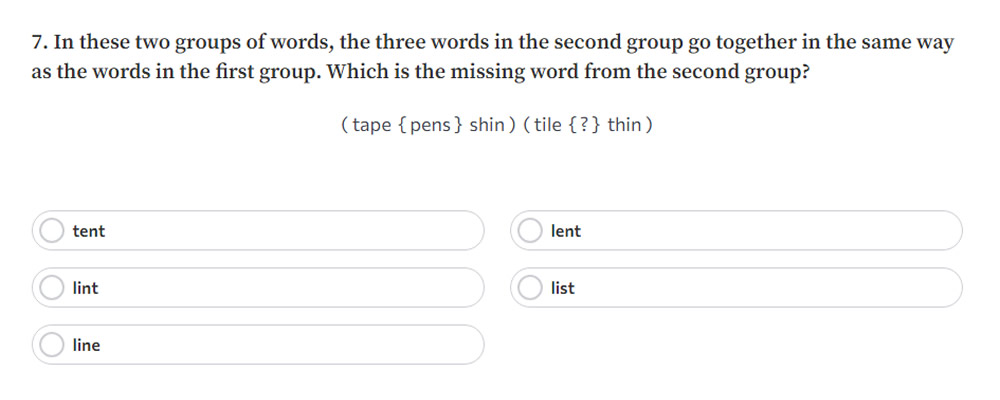
Questions that test your child’s ability to solve problems based on decoding letter strings within words
These questions include Embedded Words, Insert a Letter, Move a Letter, Word Completion, Anagrams, Jumbled Words, Missing Letters and Complete New Words.
This category rewards children for identifying and decoding letter strings. Embedded Words asks children to find a word embedded between two different words in a sentence. if your child struggles with this, practise using only two words. A good old fashioned word search can also be helpful. Anagrams, Jumbled Words and Word Completion are made easier by the context of the given sentence, so make sure your child is using this aid. Insert a Letter, Move a Letter, Missing Letters and Complete New Words require your child to change a word by moving a letter. A fun game to play is Word Strings, where you move one letter at a time and see how long you can go for (Beer, bear, fear, feat, peat, pear etc. ).