

For a parent, the exams that children sit in year 6 for entrance into senior school can sometimes feel like you’re tiptoeing through a minefield – only the mines are moving and you have other parents shouting at you from the sidelines, telling you you’re tiptoeing wrong. There are all these different exams, entry points, interviews and procedures to get into independent senior schools in the UK; it can be totally overwhelming. Fear not! Let Clarendon Tutors sweep the minefield for you and clear up any mysteries.
This week we are looking at the London 11+ Consortium, which is taking place on the 29th November, 3rd December or 5th December 2024, depending on where your child is sitting the test.
What is the London 11+ Consortium?
The London 11+ Consortium, formerly known as the North London Girls’ Schools’ Consortium, is a group of London independent girl schools that use a common entrance exam for Year 7 admissions. The Consortium was established to simplify the application process for families, ensuring that students sit for just one test rather than multiple exams for different schools. This unified approach aims to reduce stress and provide a fair assessment of each applicant’s potential. Some schools have told us that they introduced the test because they felt that girls were being over prepared for their previous 11+ exams; this was particularly evident in the creative writing component, where admissions teams sometimes saw identical essays from different candidates because girls had been prepared by the same tutor.
What Will My Child Be Tested On?
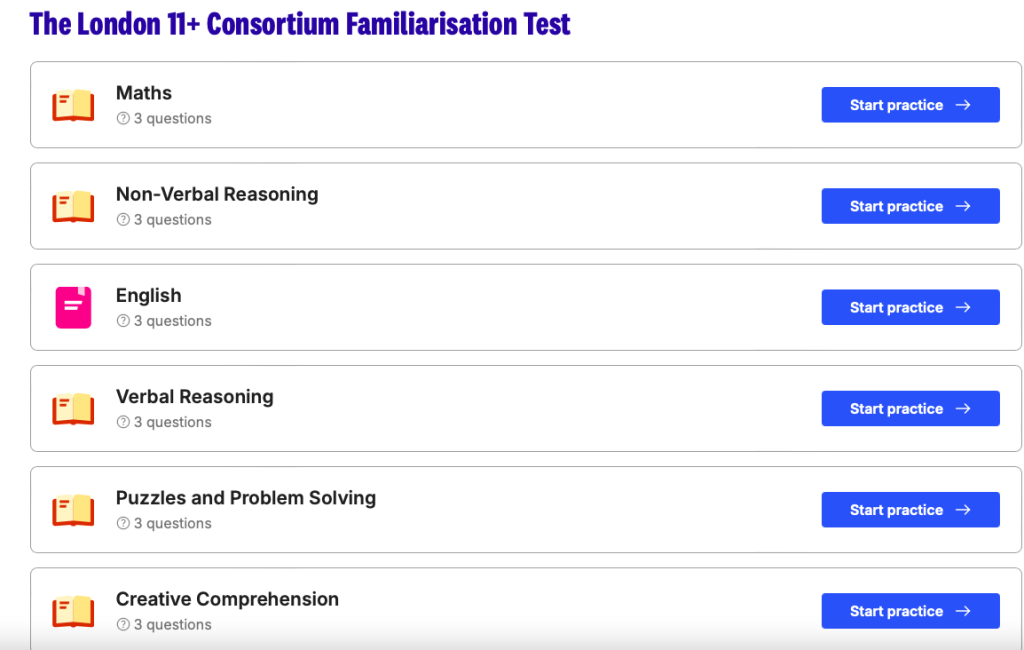
The London 11+ Consortium assessment is designed to evaluate a child’s academic potential (ie how well they might do at GCSEs), by focusing predominantly on reasoning, analytical skills and problem solving. The test lasts 100 minutes and includes the following components:
- Reasoning: Verbal and non-verbal reasoning, assessing logical thinking, pattern recognition, and problem-solving skills.
- English Comprehension: This section evaluates reading comprehension, vocabulary, and the ability to interpret and analyse texts.
- Mathematics: Covers numerical reasoning and problem-solving, requiring students to apply their mathematical knowledge in various contexts.
- Puzzles and Problem-Solving: Some tasks are designed to assess creative and analytical thinking, focusing on how well a student can apply knowledge in unfamiliar scenarios.
The test is online and adaptive, meaning the difficulty of questions adjusts based on the student’s performance, providing a more personalised and accurate measure of ability.
The test is sat in two parts.
Part 1
- Maths – 20 mins
- Non-verbal reasoning – 10 mins
- English Comprehension + verbal reasoning – 30 mins
Part 2
- Problem solving – 15 mins
- Creative comprehension and analytical skills – 25 mins
There is a familiarisation test available on Atom – View test >>
Which Schools Use the Assessment?
The Consortium includes a range of prestigious girls’ schools, such as:
- Channing School
- Francis Holland (Regent’s Park and Sloane Square)
- Godolphin and Latymer
- Northwood College for Girls
- South Hampstead High School
- Notting Hill and Ealing High School
- Queen’s College London
- St Helen’s School
Each school has its own admissions criteria, which may include interviews or additional assessments alongside the Consortium test, so double check with Clarendon if you want the exact procedure for your school.
How Should I Prepare My Child?
Preparation should focus on building confidence and competence across the test’s key areas:
- Practice Sample Papers: Familiarise your child with the test format and question types. As mentioned, Atom has a familiarisation test and many of the topics can be practised further on Atom. Additionally, EPP have their own approximation of the papers
- Develop Core Skills: The test does test attainment in Maths, English and Reasoning, which can be prepared for comprehensively with a tutor.
- Encourage Creative Thinking: Engage your child in problem-solving and puzzle activities that foster creativity and critical thinking.
A well-rounded approach will help your child perform their best on exam day.
If you want any more information, don’t hesitate to get in touch with the Clarendon Team.