

NVR is questions that test your child’s ability to problem solve based on their understanding and analysis of visual information, such as codes, diagrams, 2D shapes and 3D shapes.
NVR, under various guises, has formed the basis for “intelligence tests” for decades. There is a strong corollary between students who are good at problem solving with shapes at aged 11 and students who score highly in Maths at GCSE, with these students being able to conceptualise ideas visually.
Why does my child need to practise NVR?
Once again, this category of reasoning is one of the four components of the ISEB pre test, and one of two – along with VR – that test for academic potential, rather than academic attainment, which are tested through English and Maths.
Many London schools also use NVR as part of their entrance testing, including the London Girls’ School Consortium and City of London school.
NVR, and spatial reasoning in particular, form a large part of the CAT, which some schools use to counter an anomalously bad ISEB pretest score.
What types of questions are there and what can I do to help my child prepare for them?
Broadly speaking, there are three categories of questions:
Similarities and differences
These questions include Odd One Out, Classes Like 2 & Classes Like 3.
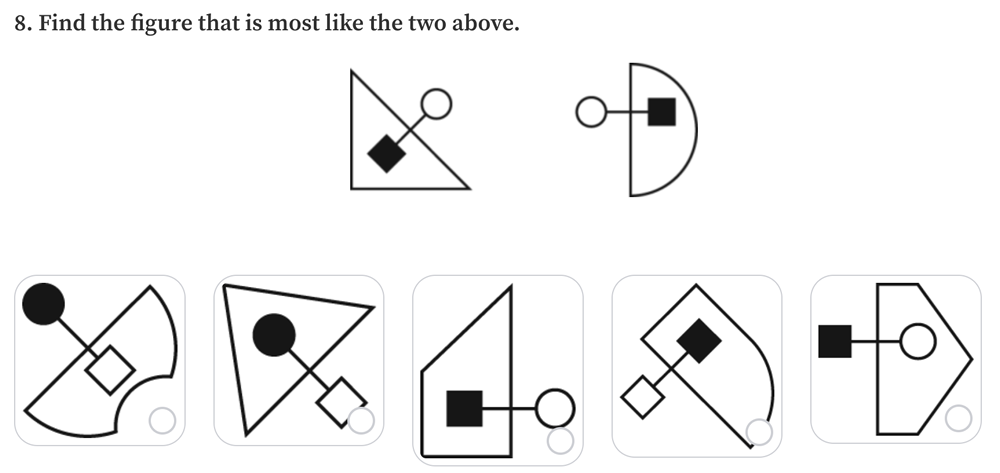
Being familiar with how to approach these questions is key. Like all multiple choice questions, elimination is important. There will usually be one or two options which are more obviously incorrect. Using a mnemonic to ensure a systematic process (SPANSS or ANSWERS) can be helpful, when trying to identify characteristics of the shapes. Once students know the process, lots of practice questions is very helpful. Beyond that jigsaw puzzles and origami can be fun ways to work with shapes.
Completing diagrams
These questions include Matrices, Series or Sequences and Analogies.
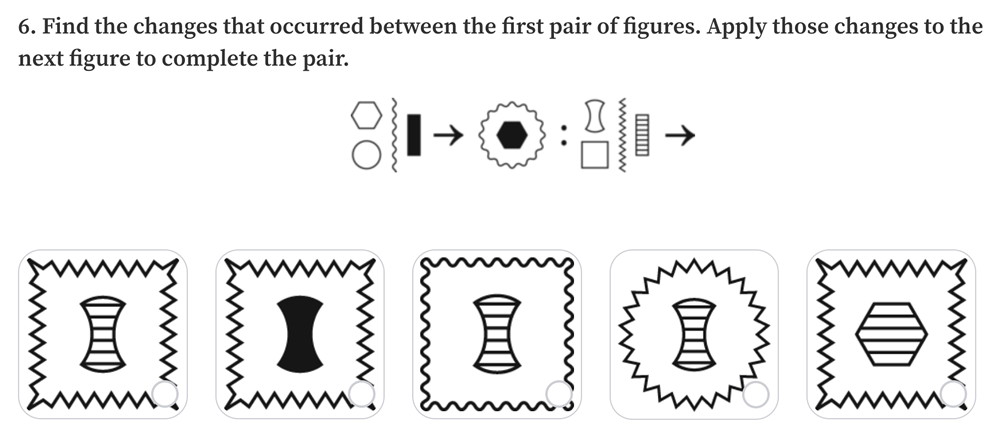
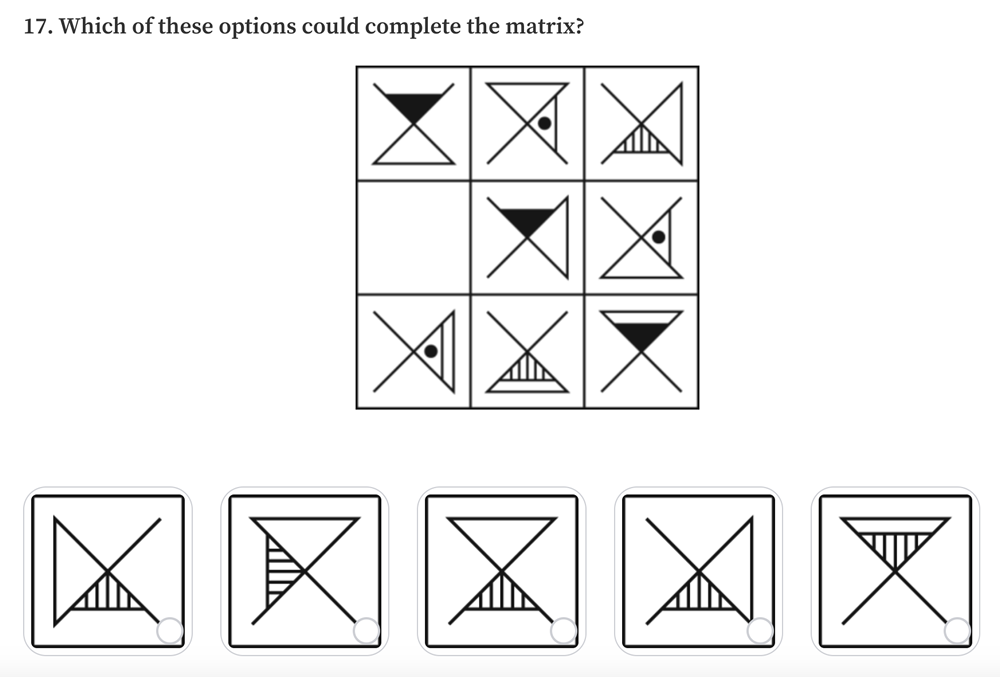
Looking for patterns which involve reflection shading positioning and size is tested in these questions. It’s amazing how quickly students improve when practising these question types. At the start, they can seem impossible, but once they’ve been shown what to look for, students quickly improve at spotting the key features. Copying shapes onto tracing paper or using mirrors can help with reflection and rotation.
Working with codes
These questions include Horizontal codes and Vertical Codes
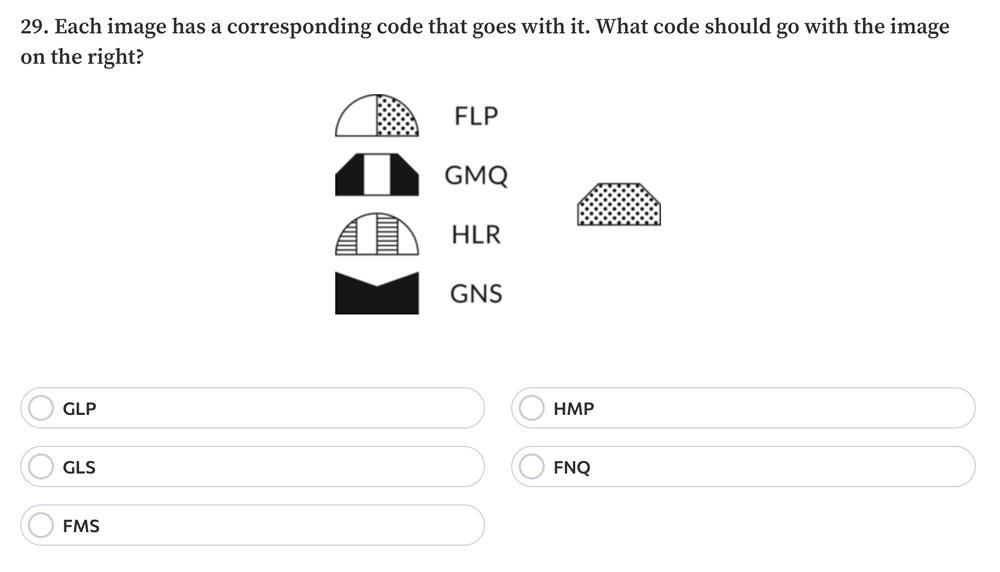
The key skill on these questions is to spot awareness of position rotation size and shading. Spot the difference books are a fun way to refine the skills needed for these question types. It’s also a good idea to familiarise your child with the properties of shapes, such as how many sides or vertices they have got. Finally, an awareness of shading is very helpful, thinking about different patterns or colours in art for example.
Spatial reasoning
These questions include Hidden Shapes, Rotation, Reflection, Nets & Cubes, Fold & Punch, 3D stacks from above and Rotating 3D shapes.


For students that struggle with spatial reasoning the best thing a parent or tutor can do is use physical objects to help them visualise what is happening. Fold and Punch can be achieved through a folded piece of paper and a hole punch. Nets & cubes can be aided by drawing shapes on each side of the cube and rotating it or by using a magnetic cube kit. The same effect can be achieved with using physical objects for Rotation, Reflection and anything involving 3D shapes. Once your child has understood what is happening, you can return to the topic on computer.